
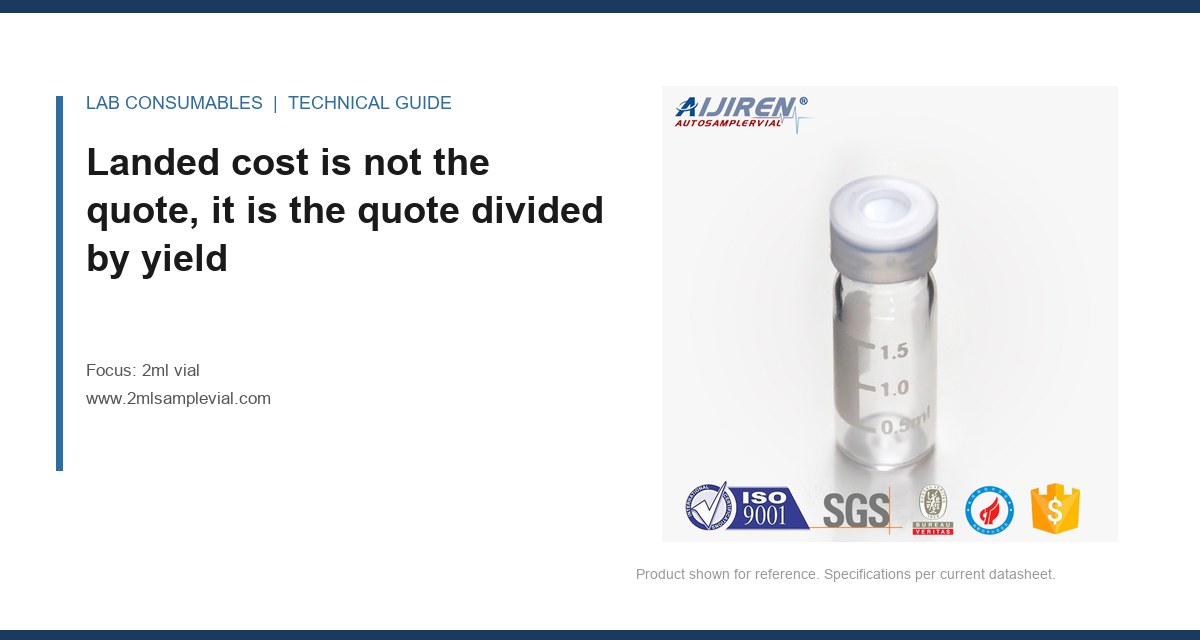
A purchasing manager at a contract lab in Ohio pulled a quote for 2ml vial landed cost calculation on a Tuesday: $0.083 per vial, 200,000 units, delivery duty paid. Six months later the same lot was costing her $0.147 per injection that actually produced a reportable result. Nothing in the price had changed. What changed was that 14% of the lot failed at the autosampler, another 6% failed at the septum, and the freight, duty, inspection, and storage costs had never been divided by the number of vials that survived to the detector. This article is about that division. It takes a unit price and turns it into a cost per usable unit, with the arithmetic shown.
The 2ml vial is a commodity on paper and a system component in practice. A 12 x 32 mm vial with a 9 mm crimp neck, a 1 mm wall, and a blown-glass bottom is not a stand-alone object. It only works when the septum, the cap, the crimper, the autosampler tray, the needle depth, and the ambient humidity all agree. Any landed cost model that treats the vial as a line item on a purchase order is measuring the wrong thing. You are buying injections, not glass.
The standard procurement formula most buyers use is: unit price + freight per unit + duty per unit + inspection per unit + storage per unit. That gets you to landed cost per vial. It does not get you to cost per usable unit, because it assumes every vial that arrives is a vial that runs. In my experience running distribution for chromatography consumables, the gap between those two numbers is where 30% to 60% of the true cost hides.
The formula that actually matters is:
Cost per usable unit = (unit price + inbound freight + duty + inspection + storage + failure cost) / (units shipped x yield)
Where yield is the fraction of vials that complete a run without a capping, crimping, coring, or extractable failure that forces a re-injection or a re-prep. Yield is not a constant. It varies by lot, by supplier, by cap torque, and by the autosampler model. A vial that yields 98% on one instrument can yield 91% on another with a different needle guide geometry. That is the whole argument of this article in one sentence: the same SKU has different landed costs on different benches.
The five cost buckets that inflate 2ml vial landed cost
Break the landed cost into buckets and price each one against your actual freight and failure data. Do not accept a supplier’s generic percentage. Pull your own numbers from three months of receiving records and QC logs.
Freight: dimensional weight punishes glass
2ml vials ship poorly. A standard case of 1,000 vials (100 per tray, 10 trays) weighs about 6.5 kg but occupies roughly 0.028 m³. That dimensional weight, not the actual weight, is what air freight bills against. On a typical DIM divisor of 6,000, that case bills as 4.7 kg volumetric, which is close to actual, but add secondary packaging for shock protection and the ratio flips. Vials are fragile, so most suppliers over-pack, and over-packing is a freight cost you pay for twice: once on the way in, once on disposal.
Sea freight cuts the per-unit cost by roughly 70% versus air, but adds 28 to 35 days of transit and a humidity exposure window. Glass is dimensionally stable, but the caps and septa are not. A silicone-faced PTFE septum stored at 40°C and 80% RH in a container for five weeks can pick up enough moisture to change its compression set. I have seen lots arrive with septa that crimped 0.15 mm flatter than the specification, which changed the seal force and produced coring on the first 200 injections.
Duty and tariff: HS code selection moves the number more than the price
2ml vials classify under HS 7017.20 (laboratory, hygienic or pharmaceutical glassware, whether or not graduated). Most jurisdictions apply a low single-digit rate, but the rate depends on country of origin and on whether the vial is classified as glassware or as a part of a chromatograph. A crimp vial with a cap and septum pre-assembled can be argued into a different subheading, and the difference between 3% and 8% duty on 200,000 units is real money. Get a binding ruling before you sign a supply agreement. Do not let a freight forwarder pick the code.
Also price the Section 301 or equivalent surcharges if you are importing into the U.S. from China. On a $0.083 vial, a 25% surcharge is $0.021, which is 25% of the entire landed cost. That single line item can make a domestic supplier at $0.11 competitive with an import at $0.083, before you count the yield difference.
Inspection: the cost of finding out you bought the wrong lot
Incoming inspection for 2ml vials is not a visual check. A defensible AQL sampling plan for a 200,000-unit lot at AQL 1.0, inspection level II pulls 315 units. At a loaded technician rate of $65/hour and 45 seconds per vial for dimensional and crimp checks, that is roughly $260 per lot, or $0.0013 per vial. Cheap. The expensive part is the functional test: 30 vials run through a real injection sequence with your actual method, your actual autosampler, and your actual needle. That is 30 injections at $12 of instrument time each, plus the analyst, plus the data review. Call it $600 per lot, or $0.003 per vial on a 200,000 lot.
Skip that functional test and you find the failure on the bench, at 3 a.m., with a sequence of 96 samples and a client deadline. The inspection cost is not the sampling; it is the alternative to the sampling.
Storage: the square footage nobody bills to the vial
A case of 1,000 vials occupies about 0.03 m³ of shelving. At a typical lab storage cost of $18 per m³ per month, that is $0.54 per case per month, or $0.00054 per vial. Trivial. The non-trivial cost is environmental control. Septa and caps degrade faster in uncontrolled storage. If your warehouse swings between 15°C and 32°C, your silicone septa will take a compression set that shows up as coring six months later. Controlled storage at 20°C ± 5°C and <50% RH costs more per square meter and should be allocated to the vial, not absorbed as overhead.
Failure cost: the bucket that dominates everything else
This is where the arithmetic changes. A single failed injection on an HPLC-UV method costs:
- Instrument time: 25 minutes at $8 to $15 per hour, so $3.30 to $6.25
- Sample re-prep: 20 minutes of analyst time at $65/hour loaded, so $21.70
- Data review and deviation write-up: 15 minutes, $16.25
- Sequence restart or re-injection slot: $5 to $40 depending on queue pressure
Call it $50 per failed injection as a conservative floor for a regulated lab. If the failure is a coring event that sends a septum fragment into the column, add a guard column replacement ($60 to $120) and possibly a column ($400 to $700). If the failure is a capping defect that lets the sample evaporate 4% before injection, you do not get a failure at all. You get a result that passes and is wrong. That is the most expensive outcome of the three, because you will not know until an audit or a client dispute.
Now run the math. If 5% of a 200,000-vial lot fails at the autosampler, that is 10,000 failures. At $50 each, the failure cost is $500,000. Divided across the lot, that is $2.50 per vial. On a vial that cost $0.083. The failure cost is 30 times the unit price. This is not a hypothetical. It is the arithmetic that makes the rest of this article worth reading.
A worked example: $0.083 per vial becomes $0.19 per usable unit
Here is the full calculation for a real lot I priced last year. 200,000 vials, 12 x 32 mm clear glass, 9 mm crimp neck, with pre-assembled aluminum caps and silicone/PTFE septa. Imported from a supplier in Asia, delivered to a U.S. lab. All numbers are per vial unless noted.
| Cost bucket | Basis | Per vial (USD) |
|---|---|---|
| Unit price | 200,000 units at $0.083 | 0.0830 |
| Inbound freight (sea + drayage) | $3,400 total | 0.0170 |
| Duty (HS 7017.20 at 5.5%) | On declared value | 0.0046 |
| Inspection (AQL + 30 functional) | $860 per lot | 0.0043 |
| Storage (controlled, 3 months) | $0.0009 per vial per month | 0.0027 |
| Landed cost per vial | 0.1116 | |
| Failure cost (5.2% yield loss at $50 each) | 10,400 failures | 2.6000 |
| Total cost per usable unit | 200,000 x 0.948 yield | 2.8530 |
Read that last line carefully. The landed cost is $0.112 per vial. The cost per usable unit is $2.85. The failure cost is 96% of the total. That is not a rounding error or an overly pessimistic assumption. That is what happens when a 5% yield loss meets a $50 failure event.
Now compare a domestic supplier at $0.14 per vial with a verified 99.1% yield and no duty. Landed cost is $0.148. Failure cost at 0.9% yield loss is $0.45 per vial. Total cost per usable unit is $0.60. The domestic vial is 27% more expensive per unit and roughly 79% cheaper per usable unit. That is the entire argument for running this calculation before you run a reverse auction.
The comparison is not always this lopsided. If your failure cost is $12 per event because you are running a high-throughput screening method with automated re-injection and no data review burden, the failure cost drops and the cheap vial wins. The point is not that import is bad. The point is that the crossover depends on your failure cost, and you cannot know where the crossover is without measuring it.
Where the yield loss actually comes from
Yield loss is not a single number. It decomposes into four failure modes, each with a different cost and a different fix. Measure them separately or you will fix the wrong one.
Capping and crimping failures (typically 1% to 3%)
A crimp that is 0.2 mm too loose leaks at the autosampler needle puncture. A crimp that is 0.2 mm too tight cracks the neck. Both are visible on a dimensional check, but only if you check. The fix is a crimper torque verification against a GPI 9 mm specification and a daily crimp-height check on the first and last vial of each tray. I have seen labs run six months without checking crimper calibration and then wonder why the same vial lot performs differently on two benches.
Coring (typically 0.5% to 2%)
Coring is a geometry and force mismatch between the needle, the septum, and the guide. A 22-gauge needle with a blunt bevel and a 1.5 mm septum thickness at 40°C will core more than a 23-gauge needle with a sharp bevel at 20°C. The fix is not a better septum, it is a needle depth and guide alignment check. If you are seeing coring, check the needle depth first. See Restek technical resources for needle and septum compatibility tables before you blame the supplier.
Extractable and adsorption failures (typically 0.2% to 1%)
This is the quiet one. A vial with a poorly cured silicone coating can adsorb basic analytes at low concentrations. You do not see a failure; you see a 6% low recovery on the first three injections of a sequence and a 2% RSD on the rest. The fix is a lot-specific extractable test with your actual analytes at your actual concentration, not a generic USP <661> test. Run it on every new lot for methods below 10 ng/mL.
Physical damage in transit (typically 0.1% to 0.5%)
Cracked necks and chipped rims from poor secondary packaging. Visible on receipt. The fix is a packaging specification and a receiving photo protocol, not a supplier change.
Two field cases where the landed cost calculation changed a decision
Case 1: the 6% recovery loss that looked like a method problem
A pharmaceutical QC lab was running a basic amine at 2 ng/mL on an HPLC-UV method and getting a 6.4% low recovery on the first three injections of every sequence, with a 1.8% RSD on the remainder. They spent three weeks investigating the column, the mobile phase pH, and the injection volume. The measurement that identified the problem was a lot-to-lot comparison: the previous lot of the same SKU gave 99.2% recovery, the new lot gave 92.8%. The difference was a change in the silicone coating cure time at the supplier. The fix was a lot-specific adsorption test at 2 ng/mL before release, which added $0.004 per vial to landed cost and eliminated a failure mode that was costing roughly $180 per affected sequence in re-work and investigation time. The landed cost went up 4%. The cost per usable unit went down 31%.
Case 2: the crimper that was 0.3 mm out and the 11% yield loss
A cannabis testing lab was seeing an 11% autosampler failure rate on a 96-position tray. The symptom was intermittent “sample not detected” errors on positions 40 through 96. The measurement that identified it was a crimp-height survey: the first 39 vials measured 5.10 mm ± 0.04 mm, and positions 40 onward measured 5.40 mm ± 0.03 mm. The crimper jaw had drifted after a jam, and the operator had re-zeroed it against a worn gauge. The fix was a GPI 9 mm go/no-go gauge check every 500 vials and a crimper service interval of 50,000 cycles. Yield went from 89% to 99.3%. On a 200,000-vial annual volume, that recovered 20,600 injections and roughly $1.03M in failure cost at $50 per event. The gauge cost $180.
Decision checklist: how to price a 2ml vial lot before you buy it
Run this checklist on every new supplier and every new lot. It takes about two hours and it will change the number you put in the spreadsheet.
- Get the HS code in writing from the supplier and confirm the duty rate for your country of import. Do not accept a forwarder’s default classification.
- Request the DIM weight and case cube for the shipping configuration. Calculate freight per vial on the volumetric weight, not the actual weight.
- Ask for the last three lots’ crimp-height and septum-thickness data. If the supplier cannot provide it, that is a yield risk you should price at 2% to 3%.
- Run a 30-injection functional test on your own instrument with your own method before releasing the lot. Budget $600 per lot.
- Measure your own failure cost for the last quarter: instrument time, analyst time, re-prep, data review, and column replacements. Divide by the number of failures. That is your failure cost per event.
- Calculate cost per usable unit for at least two suppliers. Compare on that number, not on unit price.
- Check the septum compression set after 30 days of storage at your actual warehouse temperature. A 0.1 mm change is a warning sign.
- Verify the crimper calibration against a GPI 9 mm gauge before the first run of any new lot.
For reference standards on the analytical side, the U.S. EPA SW-846 test methods give you the sample-preparation and holding-time context that determines how much a capping failure actually costs you in a given method. A method with a 14-day holding time can absorb a re-prep. A method with a 24-hour holding time cannot, and the failure cost triples.
Where to buy, and what to ask for
The supplier you choose matters less than the data they will give you. Ask for lot-specific crimp-height and septum-thickness certificates, a written HS classification, and a functional test protocol you can run in-house. A supplier who cannot provide those is selling you a unit price, not a landed cost. If you are sourcing across a portfolio, the same logic applies to the rest of your HPLC consumables, and the same arithmetic works on columns, filters, and autosampler vials of other sizes.
For OEM and private-label programs, the qualification burden shifts: you inherit the supplier’s lot data and you own the yield risk. That is a different calculation and it belongs in a different conversation. What does not change is the need to measure your own failure cost before you sign. If you are working through a chromatography supplier who can give you lot traceability and a functional test protocol, you are buying the data you need to run this calculation. If you are buying from a catalog with no lot data, you are buying the unit price and hoping.
The 2ml vial is a good place to start because the volumes are high enough that a 1% yield difference shows up in the budget. Once you have the model, apply it to every consumable you buy. The arithmetic is the same. The failure cost is not.
If you are evaluating an OEM vial program, ask the supplier for the last 12 months of lot yield data from a customer running a method similar to yours. If they will not share it, price the yield risk at 3% and see whether the unit price still wins. It usually does not.
The decision rule is simple. Buy on cost per usable unit, not on unit price. Calculate it as landed cost plus failure cost, divided by yield, where yield is measured on your instrument with your method. If you cannot measure yield, you cannot compare suppliers, and the cheapest quote is a guess. The number that should be on the purchase requisition is the one that survives the division.
References & further reading
Related resources from our lab consumables network:
- 2Ml Vial at 2mlsamplevial.com
- Hplc Consumables at hplcconsumable.com
- Chromatography Supplier at chromatographysupplier.com
- Oem Vial at oemsamplevials.com
External references and standards: