
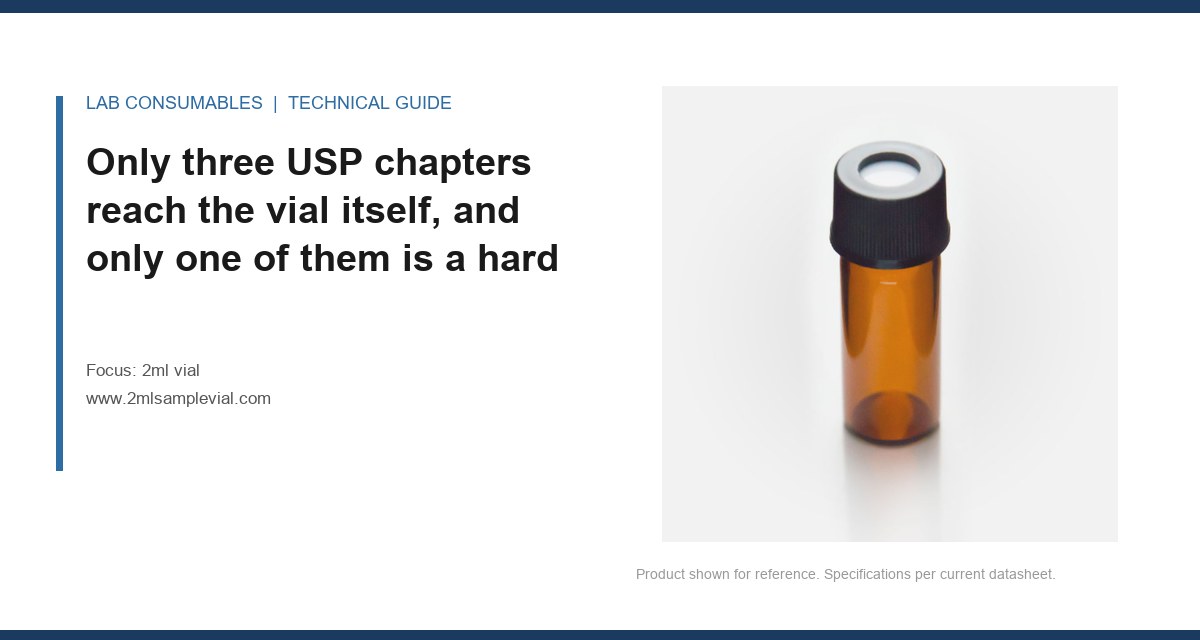
A 2 mL vial lot that had passed dimensional inspection failed system suitability on a Monday morning: five injections of the same standard gave a peak area RSD of 4.8% against a USP <621> limit of 2.0%, and the autosampler had logged 11 septum corings across 60 injections. Nothing in the method had changed. The vial had. What followed was three days of work that had nothing to do with the chromatography and everything to do with which USP chapters actually govern a consumable, and which parts of “compliance” are the lab’s own invention. If you are trying to work out what USP requirements for a 2ml vial in a validated method really are, this is the distinction that matters, because most of what gets written into a vial specification is not USP at all.
Only three USP chapters reach the vial itself, and only one of them is a hard requirement
I have sat through more supplier audits than I care to count, and the same misunderstanding comes up every time: someone has pasted “USP compliant” onto a certificate of analysis as if the whole pharmacopeia applies to a piece of borosilicate glass. It does not. The USP is written for articles and preparations, not for the containers that hold them. When you trace the chapters that genuinely impose something on a 2 mL vial, you land on a short list.
USP <660> Containers and Their Closures is the only chapter that directly specifies tests for the container. It covers glass classification by hydrolytic resistance (Type I, II, III), and it points to the biological and physiochemical test chapters for elastomeric closures. This is the one that bites. If your method uses a 2 mL vial for a parenteral or otherwise regulated preparation, the glass type and the closure testing are not optional, and the supplier’s claim has to be traceable to a test method, not a marketing line.
USP <661> Plastic Components and Systems Used to Manufacture Pharmaceutical Products applies when the vial or its components are polymeric, or when you are qualifying a plastic closure or liner. It is a biological reactivity and physicochemical test chapter. Most 2 mL vials are glass, so <661> usually applies to the cap liner or to a plastic-bodied vial, not the vial body.
USP <381> Elastomeric Closures for Injections is where the septum lives. It sets out fragmentation, self-sealing, and penetrability testing. If your validated method includes a septum that gets punctured by a needle, <381> is the chapter that gives you a testable number to point at when a lot cores.
Everything else people cite, <621> chromatography, <1058> analytical instrument qualification, <1225> validation of compendial procedures, is about the method or the instrument. Those chapters reach the vial only indirectly, through the performance the method demands. That is the whole game. The vial has no standalone USP monograph. It has a container chapter, a closure chapter, and then it has to survive whatever your validated method throws at it.
USP <660> sets the glass type, and your method sets everything else
Here is the practical consequence. USP <660> will tell you a Type I borosilicate vial is required for a given preparation and will give you the hydrolytic resistance test that classifies the glass. It will not tell you the vial’s outer diameter, its height, its neck finish, its wall thickness tolerance, or its dimensional consistency lot to lot. Those are the parameters that actually cause autosampler failures, and the USP is silent on all of them.
I have watched a procurement team reject a perfectly compliant Type I vial because it “wasn’t USP.” It was. The problem was that the lot’s outer diameter ran 0.4 mm over nominal, the gripper on the autosampler could not seat it consistently, and the resulting needle depth variation produced the RSD failure. No USP chapter covers that. The dimensional envelope is a lab specification problem, and it is the one that quietly owns most of your method robustness. If you have not written a dimensional control into your incoming specification, you have left the most failure-prone parameter ungoverned.
So the split is clean. USP <660> governs glass chemistry. Your validated method governs physical fit and function. When a supplier says a vial is “USP compliant,” ask which chapter. If the answer is <660> and your failure was dimensional, the compliance claim is true and irrelevant. This is exactly why I tell people to start with the instrument and the method’s physical demands before they start quoting chapters, a point covered in more depth in the site’s piece on 2 mL vial selection.
USP <381> turns coring from an argument into a measurement
The fragmentation and self-sealing tests in <381> are the closest thing the USP gives you to a septum performance number. In practice, the chapter’s test is a pass/fail on particulate generation and reseal after puncture. It is not a puncture-count specification. That gap is where most real-world septum disputes live.
What <381> gives you is a defensible test method. If a lot cores, you can run the fragmentation test and get a number instead of a debate. What it does not give you is the number your autosampler needs. That comes from the method. A validated method that runs 96 injections from a single vial needs a septum that reseals cleanly for at least that many punctures at the needle gauge in use. I specify ≥100 punctures for a standard 2 mL septum on a 22-gauge needle, tested to <381> fragmentation criteria, and I write that into the purchase specification because the USP will not.
The failure mode I see most is not a bad septum. It is a septum that was never qualified against the actual puncture count the method demands. A supplier ships a closure that passes <381> at the reference puncture count, the lab runs 96 injections, and by injection 70 the reseal has degraded enough to admit air. The fix is not a better chapter reference. It is a puncture-count specification in your own method validation, tied to the <381> test as the measurement method. If you are sourcing closures, this is the conversation to have with your chromatography supplier before the lot ships, not after it fails.
What <621> actually demands of the vial, and what it does not
USP <621> is the system suitability chapter, and it is where most labs first feel the vial’s influence. The chapter sets the acceptance criteria: tailing factor, resolution, theoretical plates, and the RSD of replicate injections. It does not mention vials. But every one of those criteria is downstream of the vial, because the vial is what the autosampler physically handles and what the sample sits in.
A vial that seats inconsistently changes needle depth. Needle depth changes the volume drawn. Volume drawn changes peak area. Peak area scatter is your RSD. So a dimensional or closure problem in the vial shows up as a <621> failure, and the chromatographer spends a day chasing the column. I have done this. Everyone has. The lesson is that <621> compliance is a system property, and the vial is part of the system even though the chapter never names it.
What <621> does not do is give you a vial specification. It gives you an outcome to hit. The specification that gets you there is yours to write, and it should include the parameters the chapter is blind to: cap torque, septa durometer, neck finish conformity to the GPI 13-425 thread standard, and dimensional tolerance on the outer diameter. Those are the levers. <621> is the scoreboard.
The lab’s own specification is where most of the compliance actually lives
This is the part that surprises people who come from a regulatory background expecting the USP to hand them a checklist. It does not. The USP tells you the glass has to be Type I and the closure has to pass <381>. Everything that determines whether your method runs 200 injections without a failure is a parameter you choose, justify, and defend.
Here is the specification I would write for a 2 mL vial in a validated HPLC method, with the numbers I actually use:
| Parameter | Target / limit | Governing source |
|---|---|---|
| Glass type | Type I borosilicate, hydrolytic resistance per <660> | USP <660> |
| Nominal capacity | 2.0 mL, fill volume 1.5 mL working | Method |
| Outer diameter | 12.0 mm ± 0.2 mm | Lab spec (autosampler fit) |
| Height | 32.0 mm ± 0.3 mm | Lab spec (needle depth) |
| Neck finish | GPI 13-425 | GPI standard |
| Septum material | Silicone / PTFE-faced, 1.0 mm nominal | Lab spec |
| Septum durometer | 45 ± 5 Shore A | Lab spec |
| Puncture count before reseal failure | ≥100 at 22-gauge, tested per <381> fragmentation | USP <381> + lab spec |
| Cap torque | 0.8 to 1.2 N·m applied, verified by torque tester | Lab spec |
| Extractables / leachables | Per method-specific risk assessment | Lab spec |
Notice how few rows cite a USP chapter. Two. The rest are the lab’s own decisions, and they are the ones that will fail first. The 12.0 mm ± 0.2 mm outer diameter is not arbitrary: it is what the autosampler gripper on the instruments in my lab will seat without a re-pick, and I have measured that. The 0.8 to 1.2 N·m torque range is what produces a consistent seal without deforming the septum face; below 0.8 the cap backs off during a long run, above 1.2 the septum extrudes and coring risk climbs. Those numbers came from torque testing, not from a chapter.
If you are buying vials on a spec that cites USP and nothing else, you have a spec that governs chemistry and ignores fit. That is fine until the first RSD failure, and then it is not. The OEM vial route is worth considering here, because a supplier who manufactures to your dimensional spec can hold these tolerances lot to lot in a way a catalog part cannot.
Two field cases where the chapter and the method disagreed
Case 1: the <660>-compliant vial that failed <621>
Symptom: a validated assay method began failing system suitability with an RSD of 3.9% on peak area, but only on the second and third trays of the run. The first tray was clean. The column was fine, the standard was fresh, and the instrument had passed its own qualification the week before.
Measurement: I logged the autosampler’s vial pick events and found that the gripper was re-picking on roughly 1 in 8 vials in trays two and three, and the re-picks correlated with the high-area outliers. Then I measured the outer diameter of 30 vials from the suspect lot with a digital micrometer at three positions each. Mean was 12.34 mm against a nominal 12.0 mm, with a spread of 0.3 mm. The lot was Type I glass and fully <660> compliant. It was also out of dimensional tolerance for the gripper.
Fix: we rejected the lot against the dimensional clause in our own specification (which existed, thankfully, because a previous failure had forced us to write it), and we added a three-position OD check to incoming inspection at a 10-vial sample per lot. The RSD went back to 0.6%. The lesson: <660> compliance told us nothing about the failure, and the only thing that caught it was a lab-written dimensional limit. This is the same geometry-versus-force problem that drives coring, and it is worth reading the site’s piece on HPLC consumables for the broader pattern.
Case 2: the septum that passed <381> and still leaked
Symptom: a stability method running 120 injections per vial showed a slow drift in peak area, about 1.5% per 20 injections, on the later injections of each vial. Early injections were stable. The drift was too slow to trip <621> on any single replicate set, so it went unnoticed for two weeks.
Measurement: we ran the <381> fragmentation test on the suspect lot and it passed. Then we ran a puncture-count study: same lot, same 22-gauge needle, measure reseal integrity every 10 punctures. Reseal held to about 60 punctures and then degraded. The method needed 120. The lot met <381> at the reference count and failed our method’s actual demand.
Fix: we rewrote the septum specification to require a documented puncture-count study to ≥120 punctures at the method’s needle gauge, using the <381> fragmentation criteria as the pass/fail, and we moved to a 1.0 mm PTFE-faced silicone septum with a 45 Shore A durometer. The drift disappeared. The lesson: <381> gives you the test, not the number. The number is a method decision.
What to check before you sign a method that depends on a 2 mL vial
Run this list against any validated method that consumes 2 mL vials. It is ordered by how often each item is the actual root cause, based on my own failure log.
- Is the glass type stated and traceable to <660>? If the answer is “the supplier says so,” get the test report. A hydrolytic resistance classification without a report is a claim.
- Is there a dimensional clause with numbers? Outer diameter, height, and neck finish to GPI 13-425. No numbers means no control. This is the single most common gap.
- Is the septum qualified to the method’s puncture count? Not the catalog count. Your count. Test it to <381> fragmentation and write the number down.
- Is cap torque specified and verified? 0.8 to 1.2 N·m is my working range. Check it with a torque tester on a sample from each lot. Do not trust hand-tight.
- Has the autosampler been qualified against the vial lot? A 30-injection pick-event log on the actual instrument will surface gripper re-picks that no chapter will catch. Reference <1058> for the instrument side, but the vial lot is your variable.
- Is there an extractables/leachables statement? <660> and <381> do not cover it. For any method with a low-level analyte, this is a lab-written risk assessment, and it belongs in the specification.
- Does the COA cite the chapter for the right parameter? A COA that says “USP compliant” without naming which chapter and which test is a red flag. Ask for <660> for glass and <381> for the closure, separately.
If you want the vendor side of this worked through in more detail, the technical resources at Restek and the sample-handling documentation from Thermo Fisher both cover the physical fit and septum behavior that the USP chapters leave open. For the instrument-specific pick and needle-depth behavior, the Agilent consumables documentation is a useful cross-check. And if your method is a regulated environmental or waste method, the EPA SW-846 series is the parallel authority, though that is a separate compliance track from the USP one this article addresses.
The decision rule: USP governs the glass and the closure, your method governs the fit
When you write the specification for a 2 mL vial in a validated method, split it explicitly. Cite USP <660> for glass type and hydrolytic resistance, and USP <381> for the septum’s fragmentation and self-sealing test method. Then write the dimensional, torque, durometer, and puncture-count limits yourself, with numbers, and defend them against the method’s actual physical demands. A vial that passes <660> and <381> but fails your dimensional clause is not a compliant vial for your method. It is a compliant vial for a method that does not exist. The chapters are the floor. Your specification is the method.
References & further reading
Related resources from our lab consumables network:
- 2Ml Vial at 2mlsamplevial.com
- Hplc Consumables at hplcconsumable.com
- Chromatography Supplier at chromatographysupplier.com
- Oem Vial at oemsamplevials.com
External references and standards: